

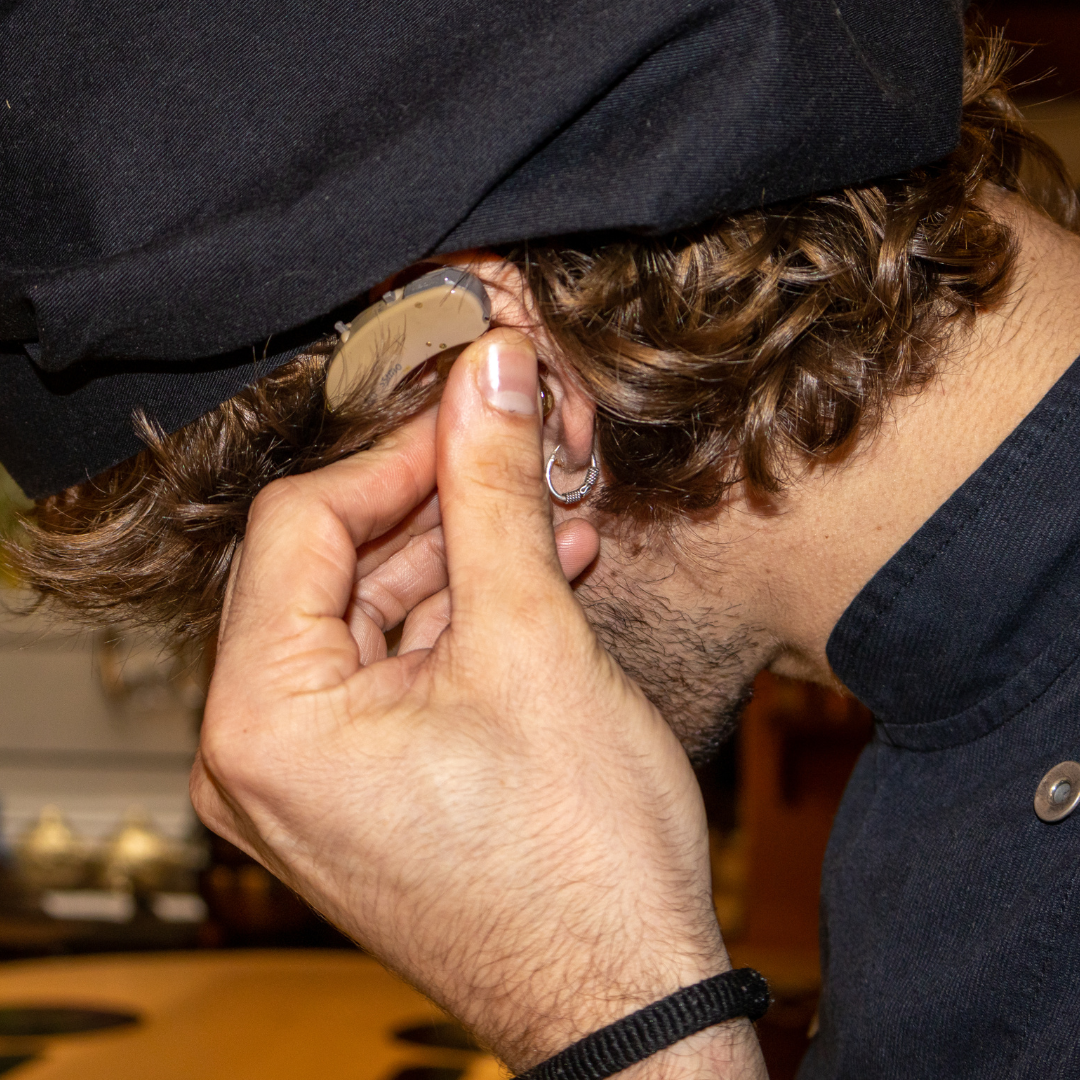
Following dinner conversations becomes challenging when high ambient noise interferes with your focus and hearing. Our practice provides targeted diagnostics to evaluate hearing in quiet atmospheres as well as complex noise environments. After uncovering the precise factors driving your difficult hearing, our team helps you select individualized auditory solutions.
How Can Hearing Seem Normal at Home but Fail in a Restaurant?
A quiet setting creates an optimal signal-to-noise ratio, ensuring the conversational partner’s voice rises cleanly above ambient sounds. Dining rooms present an unfavorable acoustic reversal of this dynamic. Competing conversations, background music, tableware clatter, and acoustic reflections clash with incoming speech, making auditory processing exceptionally strenuous.
This symptom pattern often reflects underlying high-frequency hearing loss, central processing dysfunction, or physiological aging of the auditory nerve. Visual limitations from low lighting, cognitive fatigue, and sitting farther away from conversational partners amplify speech degradation. Some people have normal results on a basic hearing test but still perform poorly on speech-in-noise testing. Disproportionate difficulty in restaurants justifies professional clinical assessment even if your everyday home hearing appears intact.
Diagnosing High-Frequency Hearing Loss and Clarity Issues
The diagnostic workup opens with an extensive intake examining difficult listening environments, past noise trauma, tinnitus presence, family history, and medical history.
Clinical pure-tone audiometry identifies hearing threshold levels across various frequencies by delivering sounds through air and bone pathways. In high-frequency hearing loss, the audiogram reveals a sloping configuration where hearing acuity drops progressively as pitch frequencies increase. Further clinical diagnostics feature tympanometry to evaluate eardrum and middle-ear mechanics as well as word-recognition testing for speech comprehension.
Since sound-treated booths cannot replicate the chaos of a crowded dining room, speech-in-noise testing provides critical real-world insight. It calculates your ability to identify verbal phrases as competing background noise levels rise. Together, these results show whether the problem involves audibility, speech clarity, background-noise processing, or a combination of factors.
How Auditory Processing Difficulties Impact Adult Hearing
Auditory processing disorders interfere with the brain’s ability to process and decipher acoustic signals arriving from the ears. The peripheral auditory system may register sounds within normal limits, yet the brain falters when separating competing acoustic inputs, sorting speech sounds, or tracking fast speech. We first evaluate peripheral hearing and then determine whether an individualized auditory-processing test battery or referrals to other professionals are appropriate.
How to Improve Speech Clarity in Challenging Acoustic Environments
Targeted behavioral changes optimize the acoustic speech signal reaching your auditory system while providing clear visual context. When planning to dine out, select restaurants with calmer atmospheres or arrange reservations during off-peak hours. Settings constructed with comfortable booths, acoustic ceiling panels, drapery, and carpeted walkways facilitate easier communication than open venues with concrete and glass.
Upon entering the restaurant:
- Ask host staff for a quiet table distanced from kitchen traffic, bar noise, audio speakers, and loud group tables.
- Position your chair against a perimeter wall to diminish competing auditory chatter behind your head.
- Ensure you sit directly across from speaking partners in an area with sufficient illumination for visual lip-reading.
- Maintain the shortest comfortable physical distance between yourself and your conversation partner.
- Turn your better-hearing ear toward the specific speaker you want to hear most clearly.
- Ask the speaker to rephrase the missed portion instead of repeating everything.
- Verifiably confirm essential conversational facts instead of bluffing comprehension.
- Step into a quiet area for a few minutes when listening fatigue begins to compromise focus.
- Ask companions to speak clearly at a natural pace.
- Elevated yelling distorts auditory signals and seldom improves actual phonetic comprehension.
Modern Audiological Tools for Managing Background Noise
Appropriate hearing technology is dictated by the precise diagnosis, primary listening environments, and the degree of diagnosed hearing loss. Prescription hearing aids fitted by an audiologist leverage directional microphone arrays, advanced digital noise reduction, and dedicated restaurant programs to focus on frontal speech while dampening background sound. However, users must maintain realistic expectations, as no clinical technology can eliminate every competing background speaker entirely.
Utilizing an external remote microphone can deliver a dramatically superior signal-to-noise ratio. The remote unit is attached to the speaker’s clothing or placed nearby, transmitting that voice straight into compatible hearing aids or an audio receiver. Direct audio routing minimizes the acoustic penalty of conversational distance and surrounding environmental din.
Further practical hearing technology options include:
- Dedicated table microphones engineered to capture small-group dialogue
- Built-in telecoils linking directly with induction hearing-loop systems in public venues
- Smartphone live-captioning platforms providing instant speech-to-text visual support
- Earbuds or hearables with compatible assistive-listening features
- Sound-level or restaurant-review tools for finding quieter locations
We will help compare available technology, verify device compatibility, and instruct you on utilizing your selected hearing equipment.
The Clinical Role of Audiologists in Managing Loud Environments
A hearing evaluation can move the conversation beyond “I hear fine in quiet.” We analyze the exact social venues, voice registers, and noise environments that cause difficulty to administer tests matching your lifestyle. Your comprehensive workup may involve pure-tone hearing thresholds, middle-ear testing, recorded word recognition, and speech-in-noise measures. Dedicated central auditory-processing testing will be scheduled if your history and primary diagnostic testing indicate central pathway issues.
Sudden, one-sided, or rapidly worsening symptoms may require medical evaluation by an ear, nose, and throat physician. Dedicated individualized care pinpoints the underlying auditory cause rather than dismissing your struggles as standard restaurant noise.
Schedule a Diagnostic Hearing Evaluation Right Away
If struggling through dinner conversation leaves you mentally exhausted, detached, or constantly guessing, schedule a complete hearing evaluation with our clinic. We provide proven treatments to enhance your hearing in noisy environments, offering hearing aid fine-tuning, specialized assistive accessories, and individualized auditory therapy.
Contact us to request an appointment and take the next step toward easier conversations.